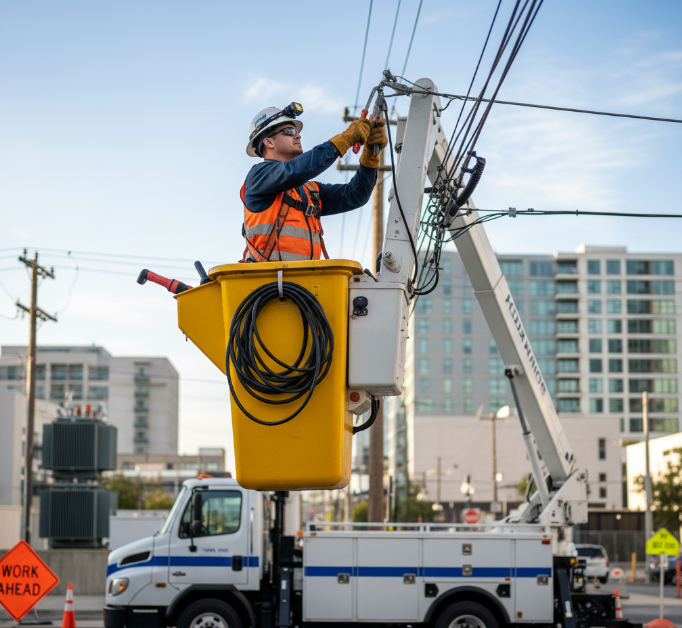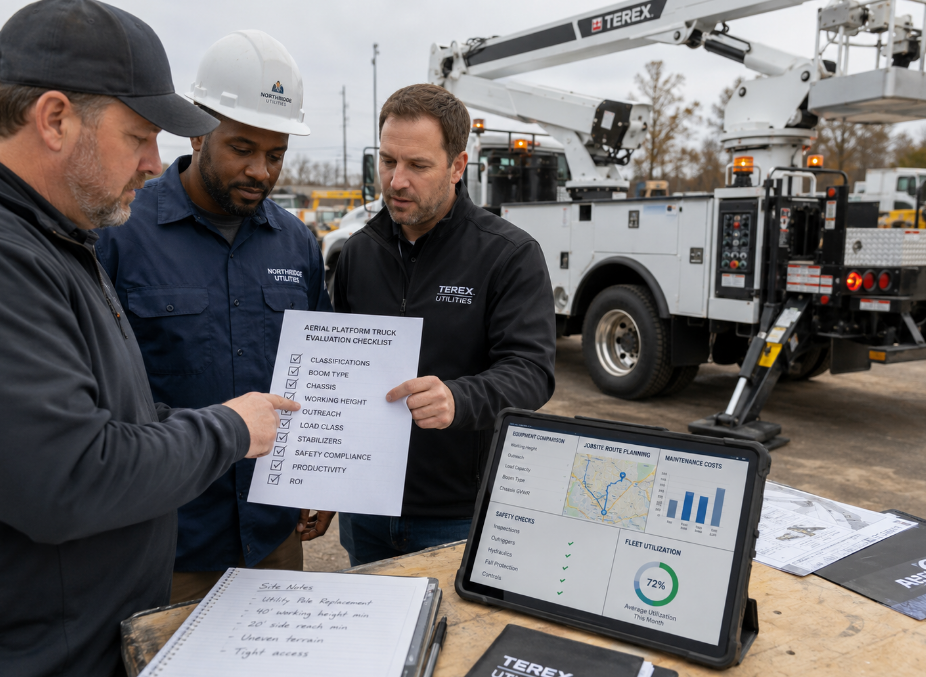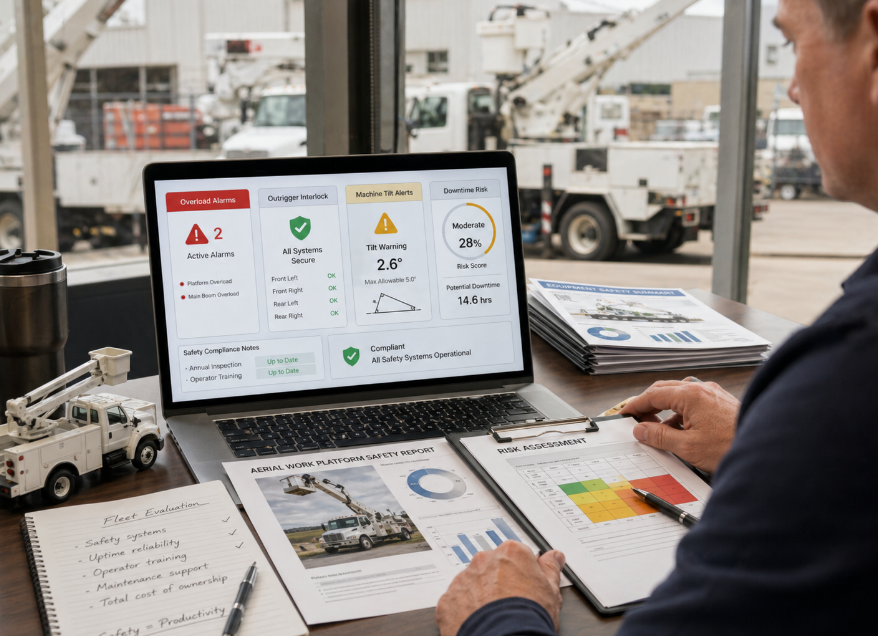
When profit meets altitude, smart safety decides who wins. For every truck mounted aerial work platform, trust gear built for real heroes.
A truck mounted aerial work platform isn’t just equipment—it’s your crew’s lifeline when the job climbs skyward and margins get tight. Safety systems decide who goes home on time and who doesn’t.
Buyers don’t lose sleep over paint color; they worry about overload alarms, outrigger interlocks, and tilt warnings that work when the wind kicks up. Smart safety design cuts downtime, lawsuits, and stomach-churning what-ifs.
5 Must-Have Safety Mechanisms on TMAWPs
Running a truck mounted aerial work platform isn’t just about height and reach. It’s about keeping crews steady, grounded, and protected every single shift. From outrigger stability to fall arrest control, every truck mounted aerial work platform depends on layered safety systems that quietly do the heavy lifting behind the scenes.
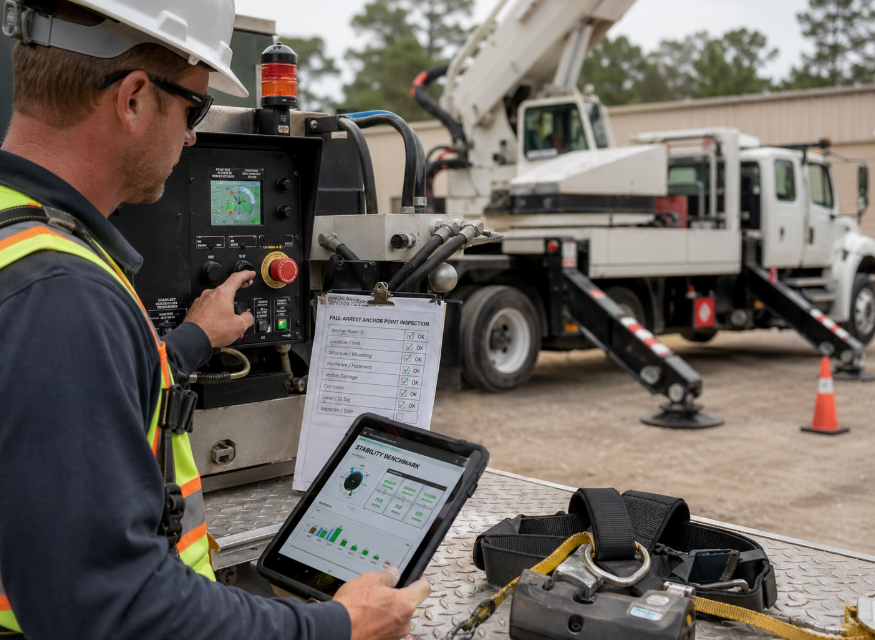
Outrigger Interlock Systems on Heavy-Duty Chassis
A properly configured interlock system on a heavy-duty chassis works like a gatekeeper. No safe setup, no boom movement. Simple as that.
Core Stability Logic
Outrigger deployment sensors verify full extension.
Ground pressure feedback confirms load distribution.
The control system blocks boom elevation until stability thresholds are met.
Hydraulic & Sensor Coordination
The hydraulic circuit only activates lift functions after sensor validation.
Each sensor feeds real-time data to the onboard processor.
The safety mechanism prevents override at height.
Stability Benchmarks
| Parameter | Minimum Threshold | System Response |
|---|---|---|
| Outrigger Spread | 100% deployed | Enable boom lift |
| Ground Pressure Balance | ±5% variance | Maintain function |
| Chassis Level | ≤1.5° deviation | Allow elevation |
On a truck mounted aerial work platform, that interlock isn’t optional. It’s what keeps the entire aerial work platform truck upright when the boom stretches out over busy streets.
Platform Overload Protection for Telescopic Boom Lifts
The platform has limits. Exceed them, and stress builds fast inside the telescopic boom lift structure.
A smart overload protection setup uses a weight sensor and calibrated load cell inside the platform floor:
Continuous weight monitoring
Automatic motion restriction
Visual and audible alarm system
When rated capacity is crossed:
Extension slows.
Lift stops.
Operators get instant feedback.
According to the 2025 Global Aerial Platform Safety Review by IPAF,
“Overload sensing systems reduce structural fatigue incidents by over 30% in powered access equipment fleets operating in urban utility sectors.”
That stat hits home for any truck mounted aerial work platform owner running daily telecom or lighting jobs. Brands like Aerialplatformtruck integrate calibrated safety device logic so the machine reacts before structural strain becomes a problem.
Emergency Stop Button Placement and Activation
Every emergency stop button—or E-stop—must be reachable without hunting for it.
On a modern truck mounted aerial work platform, placement follows layered access logic:
Platform control panel: primary operator access
Ground control station: supervisor override
Engine compartment safety switch (secondary isolation)
Activation flow inside the control panel system:
Operator presses red button.
Electrical signal cuts hydraulic solenoids.
Engine or generator output drops instantly.
Boom movement freezes.
No debate. No delay.
That direct activation path protects both the operator in the air and the ground crew managing traffic below.
Tilt Alarm Systems with Ground Control Override
A tilt alarm isn’t there to annoy operators—it’s there to prevent rollover.
Inside the chassis:
An inclinometer tracks real-time slope.
An angle sensor compares readings to programmed stability limits.
The warning system activates if thresholds are crossed.
Operational sequence on a truck mounted aerial work platform:
Slope exceeds preset degrees.
Audible alarm sounds.
Lift functions restrict automatically.
Ground control can initiate controlled boom retraction via override function.
This layered safety feature keeps stability front and center, especially on uneven construction pads or roadside shoulders.
Fall Arrest Anchor Points and Basket Leveling Systems
Working at height means tying off. No shortcuts.
Inside the platform basket:
Certified anchor point rated for fall arrest loads
Compatible with safety harness and approved PPE
Reinforced structural weld zones
At the same time, basket leveling operates through the hydraulic system:
Boom articulates or telescopes.
Leveling cylinders auto-adjust.
Platform floor remains horizontal.
That pairing—fall arrest protection plus automatic leveling—creates real operator stability.
Manufacturers like Aerialplatformtruck design their truck mounted aerial work platform models so both systems work together, not independently. When the boom swings or the turret rotates, the operator feels steady. That confidence matters on long shifts.
In the world of the truck mounted aerial work platform, safety mechanisms aren’t add-ons. They’re built-in guardians keeping crews upright, balanced, and ready for the next lift.
Safety Interlocks vs. Manual Overrides
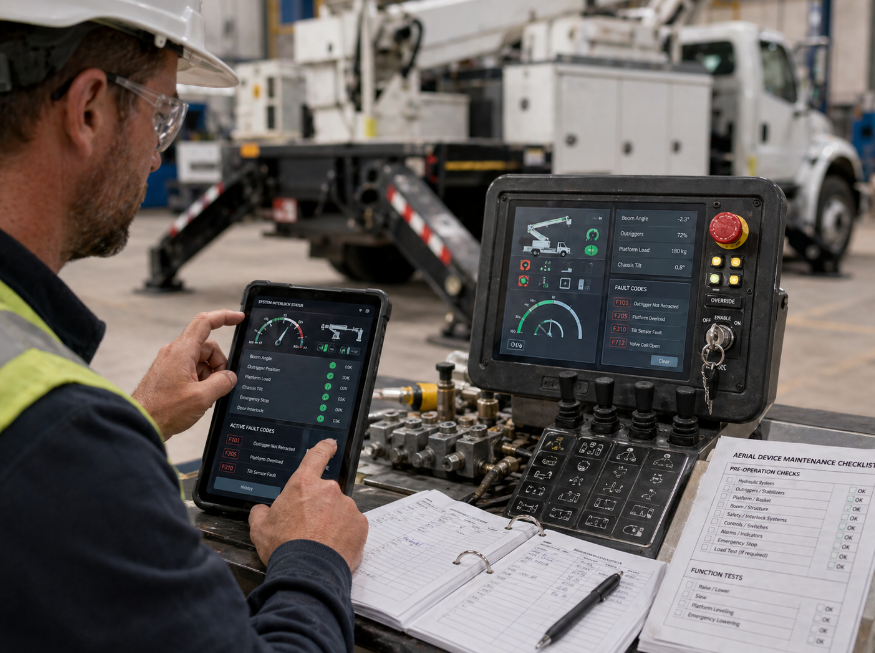
Modern lifting equipment isn’t just steel and hydraulics anymore. A truck mounted aerial work platform now runs on layered electronics, smart sensors, and tight control logic. On a busy jobsite, that matters. One wrong move with a truck mounted lift can shift weight fast. That’s where interlocks and overrides step in, keeping both gear and crew steady.
Safety Interlocks
A truck mounted aerial work platform relies on an Interlock mechanism built into its core control system. This Preventative measure ties boom angle, outrigger extension, load sensing, and chassis leveling into one coordinated Control logic network. If limits are exceeded, motion simply won’t happen. No drama. Just quiet Failure protection.
Operational safety depends on boom angle sensors
System integrity is maintained through load moment indicators
Limit detection prevents overreach before instability begins
Sensor reads outrigger extension
Controller checks rated load
Boom motion allowed or blocked
Automatic shutdown activates if thresholds are crossed
For a truck mounted aerial work platform used in urban utility work, these layers reduce tip-over risk and unintended telescoping. Aerialplatformtruck integrates stability algorithms that constantly compare live data against preset stability curves, keeping operators within safe envelopes.
Key Interlock Monitoring Parameters
| Parameter | Safe Range | Shutdown Trigger Point | Response Time (ms) |
|---|---|---|---|
| Outrigger Extension Ratio | ≥ 95% deployed | < 90% | 120 |
| Boom Elevation Angle | 0°–75° | > 78° under load | 95 |
| Platform Load (kg) | ≤ Rated Capacity | 105% of rating | 80 |
| Chassis Level Tilt (°) | ±3° | ±5° | 110 |
Inside the system architecture:
Stability Layer
Load sensors feed real-time weight data
Tilt sensors track chassis alignment
Motion Layer
Hydraulic valves receive permission signals
Boom extension locks if unsafe
Alert Layer
Audible alarm
Dashboard warning light
This structure keeps a truck mounted lift from acting outside design limits. In short, it’s smart enough to say “no” when needed.
Manual Overrides
Even the best Interlock mechanism can face edge cases. That’s where the Override function exists. Not for casual use. Strictly controlled.
A truck mounted aerial work platform may require Manual intervention during diagnostics, recovery after sensor failure, or controlled descent in a power loss event. This Bypass mechanism activates only through secured procedures, reinforcing Operator discretion and formal Backup procedure rules.
Typical override workflow on a truck mounted aerial work platform:
Confirm fault code through onboard display
Engage keyed override switch
Activate limited Emergency control circuit
Perform slow-speed boom retraction
Reset and inspect before returning to service
Within this process:
Authorization Level
Trained technician verification
Service log entry
Activation Controls
Physical key or password access
Time-limited system release
Movement Restrictions
Reduced hydraulic speed
Disabled high-angle extension
Aerialplatformtruck designs its override architecture so the System release never unlocks full operation. Only controlled auxiliary motion is permitted. That balance—strong Failure protection with disciplined Auxiliary operation—keeps the truck mounted aerial work platform practical in the field without compromising safety.
What Are TMAWP Fall-Arrest Points?
On a truck mounted aerial work platform, fall-arrest points are not random hooks welded inside a basket. They are engineered safety links built into the truck, mounted boom, and aerial work platform structure. When crews operate a truck mounted aerial work platform at height, these anchor locations quietly carry the real load—your life.
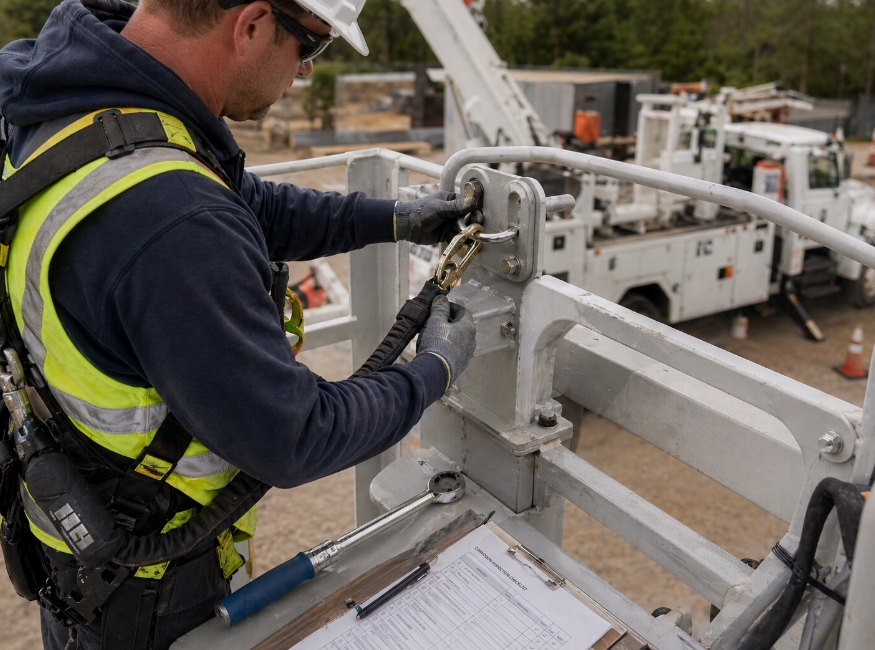
Anchor Points on the Platform Rotator
On a truck mounted aerial work platform, the anchor points tied to the platform rotator handle movement stress while keeping the fall arrest system stable.
Structural Positioning
Designed to resist torsion during 360° swing
Tested under dynamic safety harness loading
Welded to turret plates supporting boom rotation
Bolted through load-rated steel frames
Rotation Tolerance
Reinforced Mounting
Connection Interface
Shock-absorbing lanyard
Full-body safety harness
Rated D-rings
Fixed connection eyes
Compatible Gear
Approved attachment Hardware
Load Management
Static Load Capacity aligned with ANSI and OSHA
Dynamic Shock absorption during sudden stops
A properly installed rotator anchor keeps the truck mounted lift steady even when the boom extends fast and the basket shifts weight.
Integrated Lanyard Connections on Articulating Booms
Inside an articulating boom basket, integrated lanyard systems are placed with intention, not guesswork.
Key features include:
Clearly marked connection points inside the work platform
Reinforced mounts linked to the articulating boom structure
Compatibility with standard personal protective equipment
On overcenter and non-overcenter units, anchor placement reduces side-swing risk. That matters when a truck mounted aerial work platform reaches up and over obstacles. Operators clip in once, adjust tension, and keep movement smooth.
For fleet buyers comparing a bucket truck or boom truck, brands like Aerialplatformtruck design these built-in connections to align with the entire fall protection setup, not just the basket frame. Small detail, big safety payoff.
Fall Arrest Locations in Insulating Aerial Devices
When using an insulating aerial device for utility line work, fall arrest locations must protect both height and electrical exposure.
Basket Construction
Non-conductive liner
Isolated attachment points
Electrical Safety Integration
Maintained dielectric integrity
Separation from conductive boom sections
Operator Interface
Rated harness and lanyard combinations
Clear labeling meeting safety standards
In this type of truck mounted aerial work platform, the anchor system supports worker movement without compromising insulation ratings. That balance keeps crews safe around energized lines.
Inspection and Maintenance of Anchor Points
Every truck mounted aerial work platform needs routine inspection of its anchor points. Skipping checks is asking for trouble.
Daily Visual Safety Checks
Look for cracks near welds
Check corrosion around mounting plates
Confirm fall protection equipment tags are legible
Scheduled Preventive Maintenance
Torque verification on bolted anchors
Surface treatment to prevent rust
Review of structural integrity records
Documentation and Compliance
OSHA and ANSI alignment
Warranty condition tracking
Accurate record keeping
Fleet managers running a truck mounted aerial work platform or any truck mounted lift should treat anchor maintenance like brake checks—routine, logged, and never skipped. Aerialplatformtruck equipment is engineered for durability, but real-world reliability still comes down to consistent care and verified compliance.
FAQ
What safety interlocks are integrated into a truck mounted aerial work platform?
A truck mounted aerial work platform blends mechanical strength with layered protection to keep crews secure at height.
1) Stability Control
Outrigger interlocks confirm full outrigger spread and ground contact before a telescopic boom lift or articulating boom lift can rise.
A tilt alarm system warns when chassis angle exceeds the safe wind speed rating, with ground control override for recovery.
2) Load & Motion Protection
Platform overload protection blocks lift or extension once platform capacity is exceeded.
Basket leveling system maintains balance during turret rotation or jib extension movement.
3) Emergency Safeguards
Emergency stop button at platform and ground controls cuts hydraulic and engine driven generator power instantly.
Certified fall arrest anchor points inside the bucket truck platform secure harness connections.
How does platform overload protection support long-term fleet reliability?
In utility maintenance and telecommunications installation, repeated overloading can fatigue a telescoping boom or dual articulating boom. Platform overload protection prevents that silent damage.
It monitors real-time platform capacity on straight boom lift and material handling aerial device models.
When limits are exceeded, lift and horizontal reach functions pause, protecting structural welds and turret rotation components.
On heavy-duty chassis or medium-duty chassis units—diesel powered or hybrid electric—this control extends service life and aligns with preventative maintenance schedules.
The result is fewer structural repairs, steadier working height performance, and stronger resale value across construction site access fleets.
What maintenance and support can buyers expect from a truck mounted aerial work platform manufacturer?
Ownership goes beyond delivery day. A reliable service network keeps insulating aerial device and non-insulating aerial device fleets productive.
Service Backbone
Wide parts availability for telescoping boom, non-overcenter boom, and platform rotator assemblies
Clear technical documentation and diagnostic tools for field technicians
Structured operator training programs for safe street light maintenance or bridge inspection work
Lifecycle Assurance
Preventative maintenance schedule guidance matched to working height and outrigger spread usage
Warranty coverage tailored to diesel engine chassis, electric chassis, or PTO driven systems
Strong after-sales care protects uptime, supports crews in the field, and keeps every truck mounted aerial work platform ready for the next call.