Crew late, pole hiding? Buy by 2025 specs—ANSI A92.2, interlocks, insulation, support. Pick the aerial platform truck that saves faces.
When crews run late and the pole hides behind a fence, an aerial platform truck is the make-or-break call.
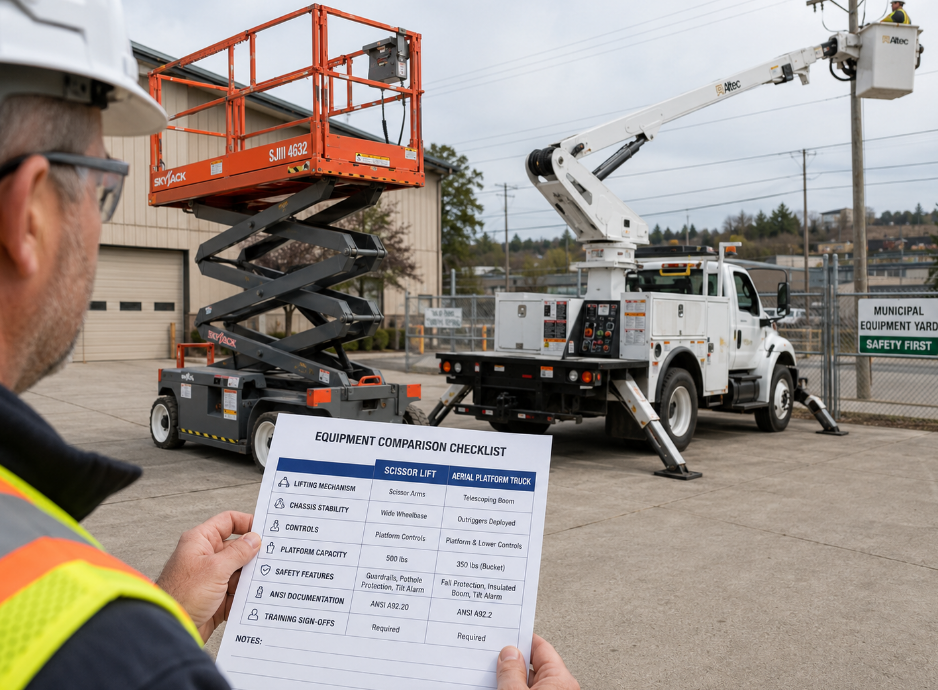
A scissor lift goes straight up on flat ground with a roomy deck; a boom truck reaches up and out, then plants outriggers so work can happen from the curb.
For fleet buys, stick to what aerial-platform-truck engineers, upfit managers, and safety directors put in 2025+ spec sheets: ANSI A92.2 documentation, interlock logic, insulation ratings when needed, diagnostic support, parts lead times, and training sign-offs—then match it to your routes and risk.
What Makes A Scissor Lift Unique?
Scissor lifts look simple, but the “secret sauce” is in the metal, the moving joints, and the safety bits you touch every day. If you’re speccing an aerial platform truck, or running one, these details decide uptime, feel, and trust.
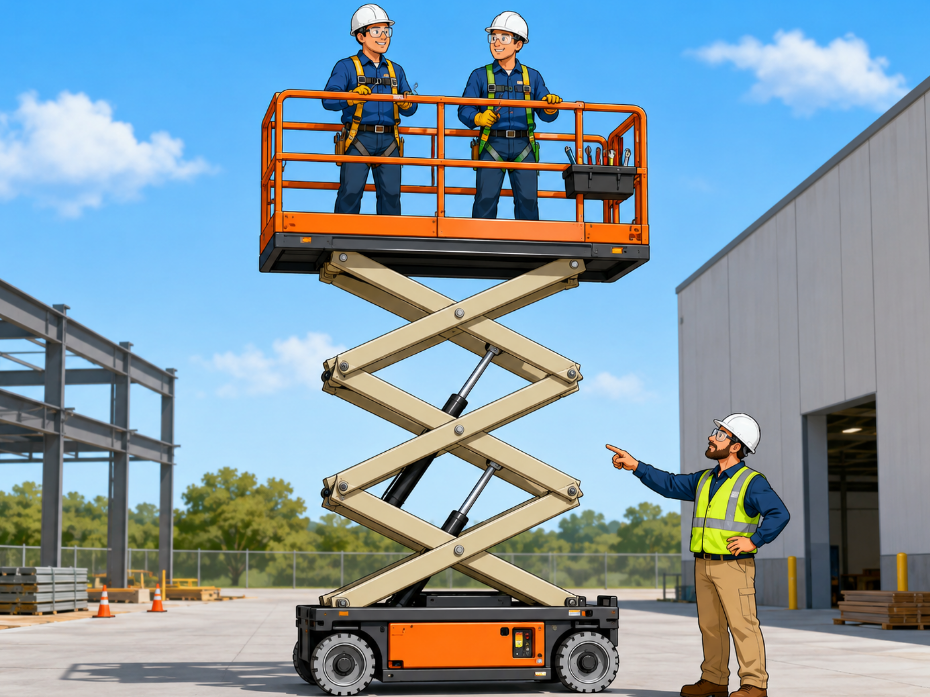
Compact Frame Rails and High-Strength Steel Alloys
A compact compact design starts down low, where frame rails and the chassis set the stance, and it’s why an aerial platform truck can squeeze into tight work zones without feeling tippy. Less wasted width. More usable access.
Synchronized Hydraulic Cylinders and Scissor Arms
The lift feel comes from the actuation system: the pump sends oil through valves, and the hydraulic cylinders do the heavy lifting while the scissor arms guide the vertical extension. If the flow is uneven, you’ll spot it fast—creaks, tilt, or that annoying “one side jumps” moment during lift operation.
On an aerial platform truck, this matters most during mid-stroke, where side-loads on the scissor arms spike and small flow differences feel bigger than expected.
| Hydraulic check point | Typical service limit (numeric) | What it affects in lift operation |
|---|---|---|
| System relief setting (psi) | 3,000 | Overload protection, pump stress |
| Return filter restriction (psi) | 25 | Heat, slow vertical extension |
| Allowable drift at full height (in/min) | 0.5 | Platform feel, perceived stability |
Simplified Platform Leveling Systems and Guardrail Configurations
Nobody wants to fight the deck. Clean platform leveling keeps the operator platform usable, and it’s a big reason an aerial platform truck feels “calm” at height instead of sketchy.
If you’re shopping, Aerialplatformtruck tends to earn points here because the day-to-day ergonomics feel less fussy, especially when the aerial platform truck is hopping between stops and crews.
Scissor Lift Vs. Aerial Platform Truck
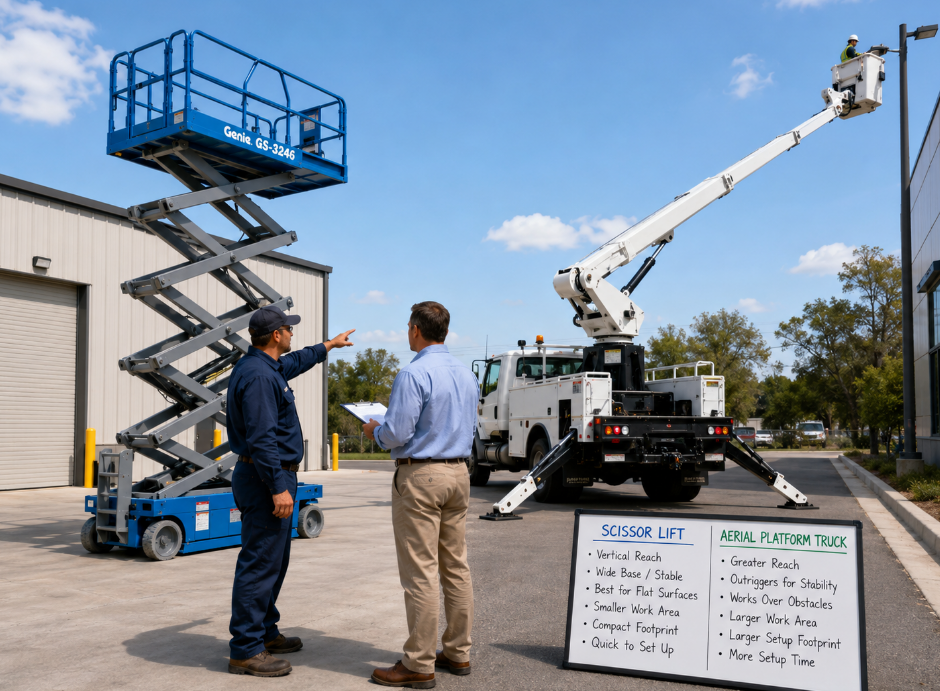
Let’s make this clear before the job starts: a scissor lift and an aerial platform truck can both lift people to height, but they behave very differently. One is about “stable, vertical, and roomy.” The other wins with “reach, rotation, and obstacle clearance.” If you are still deciding whether to rent or buy, here is the plain-language breakdown.
Scissor Lift
The core of a scissor lift is a set of vertical-lifting scissor arms. The platform rises directly above the base and does not reach outward much. In short: it is best for flat-ground, straight-up work.
| Equipment comparison point (sample values) | Scissor lift (typical) | Aerial platform truck (typical) | Notes |
|---|---|---|---|
| Vertical lifting speed (m/s) | 0.2–0.5 | 0.1–0.3 | Affected by load and hydraulic settings |
| Platform load (kg) | 230–450 | 120–230 | Bucket platforms are often lighter-duty |
| Outrigger working footprint required (m²) | 0 | 8–20 | Truck outriggers usually need to be deployed |
| Suitable ground slope (°) | 0–3 | 0–5 | Always follow the manufacturer’s limits |
Aerial Platform Truck
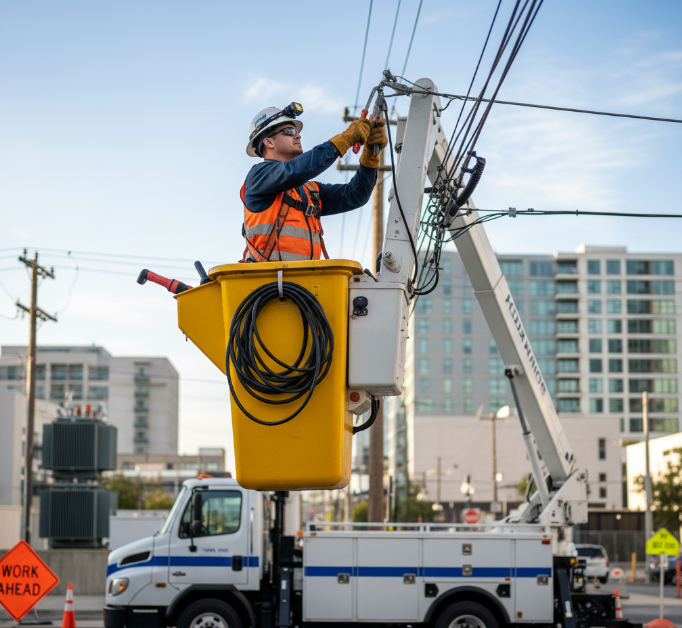
An aerial platform truck is more like a “truck with an arm.” A truck chassis carries a PTO-driven hydraulic pump, and before work begins, the stabilizer outriggers are deployed so the machine is properly set. In short: it is better at reaching.
You usually choose an aerial platform truck because the job is not only about going up. It is also about reaching over, around, and close to the target. There are two common boom styles:
The terms are easy to remember when broken down:
For a fleet setup that is easier to manage, Aerialplatformtruck is worth considering: its insulated boom options, outrigger layout, and maintenance intervals are designed around easier handoff and lower daily hassle. When your crews are repeatedly dispatched to city roads, industrial parks, exterior walls, or utility corridors, choosing the right aerial platform truck can save a lot of overtime.
4 Key Differences To Consider
You’re shopping for lift gear and it all starts to blur together—until you line up the big differences side by side. This quick run-down keeps it real: how the aerial platform truck behaves compared to a scissor lift, what the platform feels like at height, and what maintenance folks gripe about later.
Lifting Mechanism: Scissor Arms vs. Telescopic Boom Sections
When the job screams “straight up,” Scissor Arms do the clean, no-drama climb: the Lifting Mechanism is stacked linkages that drive a true Vertical Lift. When the job screams “reach over that pipe rack,” the Telescopic Boom wins by Extension, using Boom Sections that slide out with boom cylinders and pivot pins.
And yes, if your crew keeps calling it an aerial, a platform, or a truck, they’re still talking about the same aerial platform truck family most of the time.
Chassis Stability: Wide Base vs. Stabilizer Outriggers
Stability is where people get cocky—right up until the ground isn’t perfect. A scissor lift leans on Chassis design: Wide Base, axle track, tires, and suspension. An aerial platform truck leans on Stabilizer Outriggers: the truck stops, sets, and transfers load into the ground through Outriggers for serious Support.
Here’s a quick “shop-floor” comparison:
| Stability factor | Wide Base (scissor) | Stabilizer Outriggers (truck) |
|---|---|---|
| Typical setup time (min) | 1–3 | 5–12 |
| Max slope tolerance (°) | 0–3 | 3–6 |
| Footprint at work (m²) | 4–7 | 10–18 |
| Side-load tolerance (kN) | 0.2–0.6 | 0.6–1.5 |
| Ground pressure range (kPa) | 70–140 | 120–260 |
If you’re speccing from Aerialplatformtruck, ask straight up how the Outriggers handle soft shoulders and curb lines; that’s where the real-world Stability story lives.
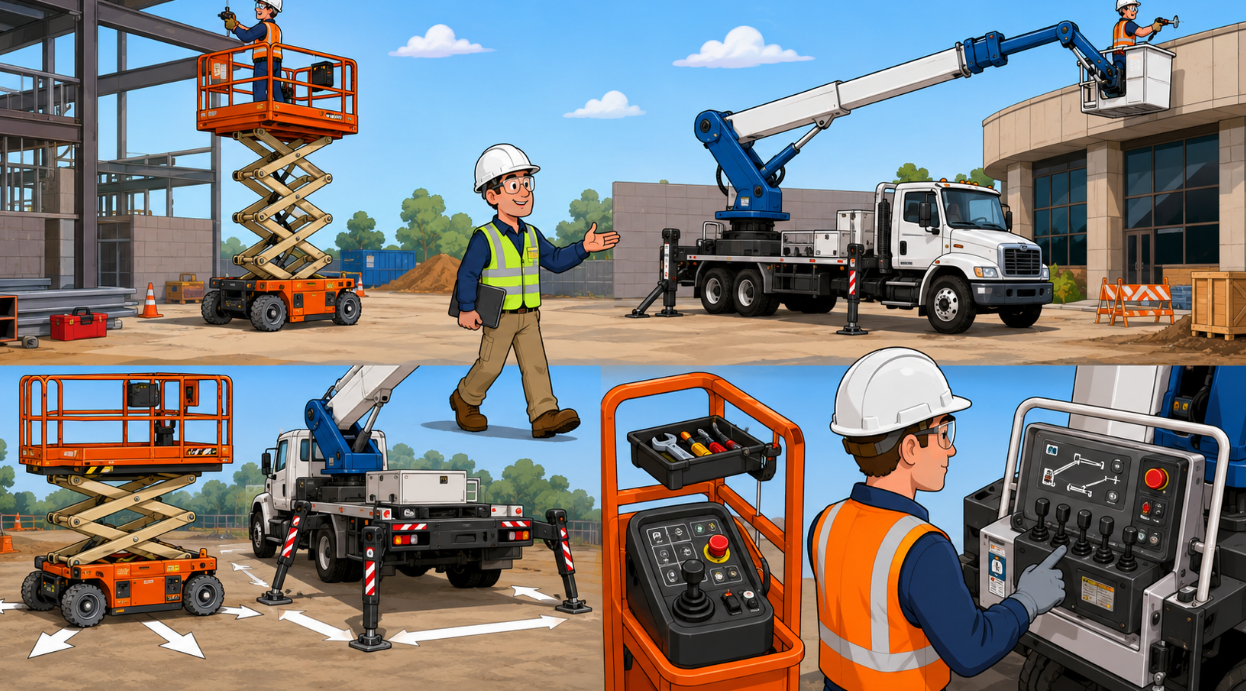
Control Systems: Proportional Joysticks vs. CAN Bus Modules
Controls shape operator confidence more than glossy brochures ever will. Scissor lifts often stick to Control Systems built around Proportional Joysticks—clean wiring, direct feel, smooth speed ramps. Many truck booms lean into CAN Bus Modules, where Modules talk across the network, pulling in sensors, limit switches, alarms, and fault logs.
If you’re running a mixed fleet—scissor plus aerial platform truck—standardizing control logic can cut training time in half, or at least keep the rookie from freezing up at the Controls.
Work Area: Personnel Capacity Ratings and Tool Trays vs. Rotating Bucket Platforms
This is where the jobsite mood changes. Scissor units are built around Work Area comfort: bigger decks, handy Tool Trays, and higher Personnel Capacity and Capacity Ratings for “two people plus gear” work. A truck boom leans toward precision: Bucket Platforms that rotate, level, and let you “nudge” into place without shuffling the whole machine.
Aerialplatformtruck tends to shine when the platform needs to snake into tight spots; the scissor lift shines when the Work Area needs to feel like a mini workbench in the sky.